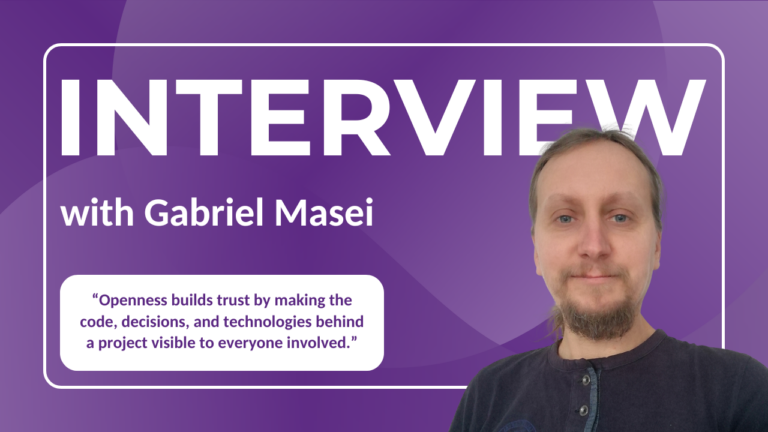

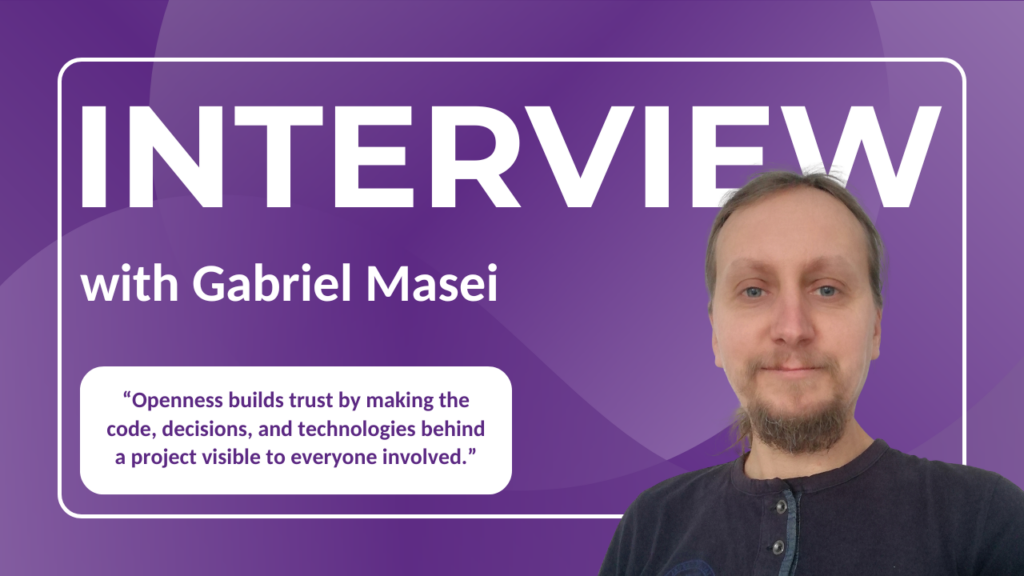
Welcome back to our interview series, where we chat with the passionate people behind the Collabora Online code. Collabora Online is made possible by the worldwide team, community, contributors and partners. Today, we’re sitting down with Gabriel Masei who has been contributing to Collabora Office since 2019.
About Gabriel
Gabriel is a software engineer and mentor. His early mathematical education naturally paved the way for a career in tech, beginning with integrating Collabora Online for a major office product deployment. Today, alongside his deep-dive architectural work, Gabriel is deeply passionate about supporting education, serving as a student mentor in Bucharest to guide the next wave of developers into the FOSS world. When he isn’t reviewing code or collaborating with global teams, he can be found navigating rivers in his kayak.
How did you first hear about Collabora Online?
In 2018, I was hired by the Romanian branch of 1&1 to help integrate Collabora Online into their Online Office product. My first direct contact with the community came later that year, at the LibreOffice Conference in Tirana.
Why did you decide to contribute to Collabora Online?
At first, the decision was mainly driven by my daily work. Since I was integrating Collabora Online, contributing to the project meant reducing the differences I would otherwise have had to deal with during future upgrades. At the same time, I was personally curious to learn what it meant to contribute to an open-source project, since I had never done that before.
What was your very first contribution to Collabora Online, and how did it feel to see it go live?
My first contribution to Collabora Online was also my first contribution to any open-source project. It happened in 2019 and involved adding support for defragmenting fragmented WebSocket messages, which was missing at the time from the protocol implementation. I had encountered issues with large messages fragmented by the browser, so I implemented the missing functionality and shared it with the community.
It was not immediately included in the release branches. A couple of months later, when the community experienced similar issues, my patch was included in the release branches. I even received a thank-you email because it helped the community resolve critical problems quickly. That was a very rewarding moment. It showed me that the project was truly open source and that anyone could contribute meaningfully, even to core components.
Which feature are you most happy to have worked on?
I don’t have a single favourite, but I could mention three of them, each one for a different reason. The first is, of course, my WebSocket-related contribution, because it was my first and remains special to me for that reason.
The second is special because I was able to provide a simple and unexpected solution. It involved improving COOL initialisation speed in Docker by finding a simple but effective workaround for a performance issue related to copy-on-write behaviour in the overlay2 driver that the community had been struggling to solve for some time.
The third is the auto-detection of CSV separators, an option added in the Text Import dialog. It is special because it is a feature that had been requested by users for a long time.
Can you share an example of how the Collabora community has supported you in your contributions or learning?
I have received support from the community multiple times and in multiple ways: at the code level, by receiving suggestions for difficult issues or explanations of how certain features work internally; by getting help in guiding students in the university program I’m involved in; and even by receiving support in organising the LibreOffice Conference in Bucharest in 2023.
One example I’d highlight is my work with students in the CDL – Community and Development Lab program at the University Politehnica of Bucharest organized by ROSEdu. The program introduces students to the open-source world and guides them toward making their first contributions. I mentor students working on both Collabora Online and LibreOffice, and community support has been essential—especially in reviewing patches and helping students navigate the development process. That support has made a real difference, both for the students and for the project, since some students choose to continue contributing to the project even after the program ends.
How does contributing to open source connect with your personal values or professional goals?
Among the core principles and values of open-source culture, two of them stand out as crucial from my perspective and relate directly to my personal values: meritocracy and openness. I believe the best ideas should win, and people who contribute valuable work should be heard, recognised, and encouraged to become more involved in all aspects of the community.
For that to happen, a community needs to be open—so that ideas and contributions can be evaluated fairly and transparently. Beyond that, openness also builds trust by making the code, decisions, and technologies behind a project visible to everyone involved.
What advice would you give to someone wanting to start contributing?
Engage with the community. Not doing so was a mistake I made at the beginning, and as a result, it was much more difficult for me to understand both the inner workings of the project and some important details. Although I managed to deal with the issues, I later realised that many days of work could have been saved if I had interacted with the community earlier. At that time, I had never been involved in an open-source project before, and I was somehow afraid of “disturbing” people in the community. But now I know that this is not the case, because collaboration is one of the main principles that guide open-source communities.
You’ve joined us at a few COOL Days events now – what’s your most memorable moment over the years?
For me, the most memorable part of COOL Days is reconnecting with people from the community after a long time. The conference is great for staying up to date with the project and exchanging ideas, but a lot of the technical information is also available online. What you can only fully experience in person is the direct interaction with the people behind the project.
How has attending COOL Days impacted your contributions or connected you with other community members?
One of the biggest benefits of attending COOL Days is that many—if not all—of the key stakeholders are in the same place at the same time, which makes collaboration much easier. In some cases, I received critical technical advice that helped me solve pressing issues, and I’m very grateful to the community members for that. In other cases, attending COOL Days helped me better understand certain features or bug fixes by allowing me to speak directly with the people involved in implementing them. As a developer, that kind of insight is extremely valuable when making future technical decisions. For example, at this year’s edition, I was able to speak directly with the people behind the AI Assistant, a cool new feature introduced in COOL 26.04.
What’s the most rewarding part of interacting with other contributors or users in the Collabora Online community?
Definitely the exchange of experience. Getting in touch with people from around the world, from different cultures, with different habits and ways of thinking, is truly rewarding. The technical discussions are always valuable, but the human aspect matters just as much.
What does working with open source mean to you – why is this important?
To me, working with open source means collaboration, transparency, and knowledge sharing. The learning aspect is very important, because you get exposed to different ideas, techniques, and architectures. The non-technical side is also worth mentioning, since interacting with open-source community members gives you the opportunity to connect with different cultures as well. For example, nowadays I spend a significant amount of time supporting education through open source, and that comes primarily from my passion for it. As for tech in general, it came naturally to me. I received a strong mathematical education from an early age, so it’s not surprising that technology became one of my preferred fields.
What’s one myth or misconception about contributing to open-source projects that you’d like to debunk?
There are many misconceptions about open source. I myself believed some of them before getting involved in open source. But the one I’d most like to debunk is the idea that “open source is built by amateurs and has poor quality.” Nothing could be further from the truth, and my direct experience has shown the exact opposite.
Some of the most complex, important, and widely used software systems in the world are open source. Many of the foundational systems that power the internet, mobile devices, and even aerospace systems are open source. You cannot build systems of that complexity if you are just an amateur, and they would not be used at such a scale if they were of poor quality.
Outside of your work, what’s a hobby or interest that you’re passionate about?
Kayaking. I was born and raised in a small village on the banks of the Danube, and as a child I spent many days on the river—fishing, rowing, or swimming. Later, I discovered kayaking on rivers, and it has remained one of my favourite activities.
I recently discovered something that definitely surprised me: my involvement in education. I never imagined that I would enjoy doing something like this so much. I truly enjoy interacting with students, sharing my knowledge and experience, and learning about each student’s unique approach to solving a problem. Sometimes the solution is so unexpected that it leaves you speechless.
Gabriel’s progression from a hesitant contributor, to a mentor for university students as they submit their very first patches, highlights the supportive, forward-thinking culture of open source. We are grateful to Gabriel for his ongoing contributions both to the software and to the developers of tomorrow.
Whether you are an experienced software engineer or a student looking for your first breakthrough in tech, there is a place for you in the Collabora Online community.