
Sovereignty or Legacy, You Choose
There is a lot of energy right now around European digital stacks. Self-hosted infrastructure. Local control. Reduced dependence on American cloud vendors. And all of that matters.
It seems to be a pattern that people take other people’s software that they have not written, and will struggle to support and put their brand on it, and wrap a European flag around it
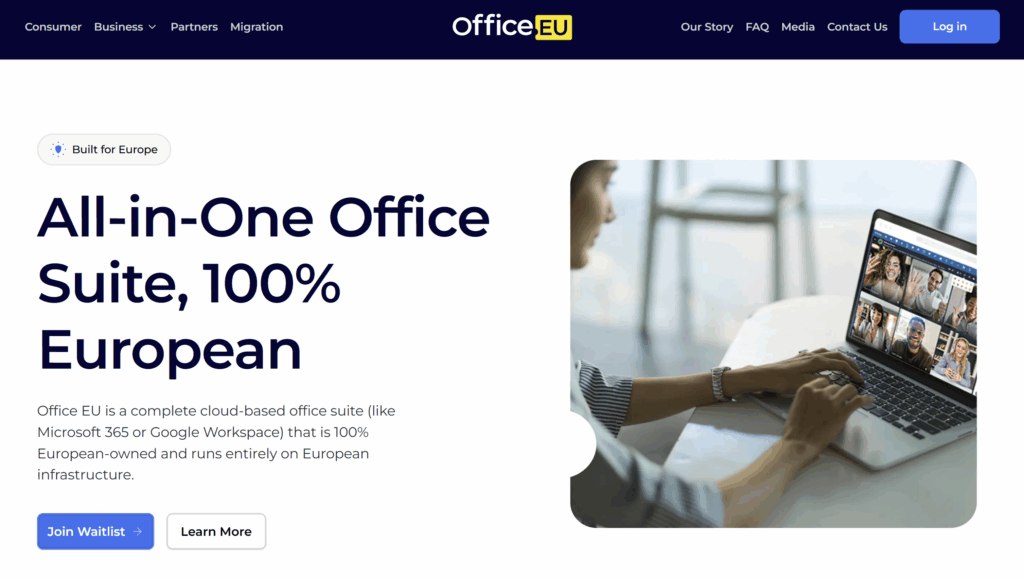
But we should be honest about one thing – you are not sovereign if Microsoft still defines the fundamental design of your application, as well as your document formats.
You can move the server. You can change the branding. You can even swap out one vendor for another. But if the office layer at the heart of your stack is still at root built around Microsoft’s file formats, then they still set the rules that matter most. Your documents live inside a model you do not control, cannot meaningfully govern, and have no real power to shape.
That is not digital sovereignty. That is a hosting decision.
Self-hosting is not the same as sovereignty
A self-hosted office suite built around OOXML may reduce dependency on Microsoft 365 as a service. It may reduce exposure to American hyperscalers. It may tick some procurement boxes. But it does not solve the deeper problem – after all, you could do this with SharePoint 2019 till recently.
OOXML is Microsoft’s document model, standardised after the fact. Microsoft’s own documentation clearly describes .docx .xlsx and .pptx as formats to “support the features and behavior of Microsoft Office” while noting that ODF and Open XML reflect different application behaviours and feature sets. These are not neutral containers floating above the market, they reflect the architecture, priorities and direction of the organisations that created them.
That matters because formats are not just a way to save files. They encode the document model itself: what features exist, how layouts behave, how compatibility is judged, what gets preserved, and what gets lost. If you open an .odp presentation with the total slide count in the template in Microsoft PowerPoint, or save the file as a .pptx for example, PowerPoint and the .pptx file format simply throw away the information. If you want that feature back, good luck with the Microsoft support forums…
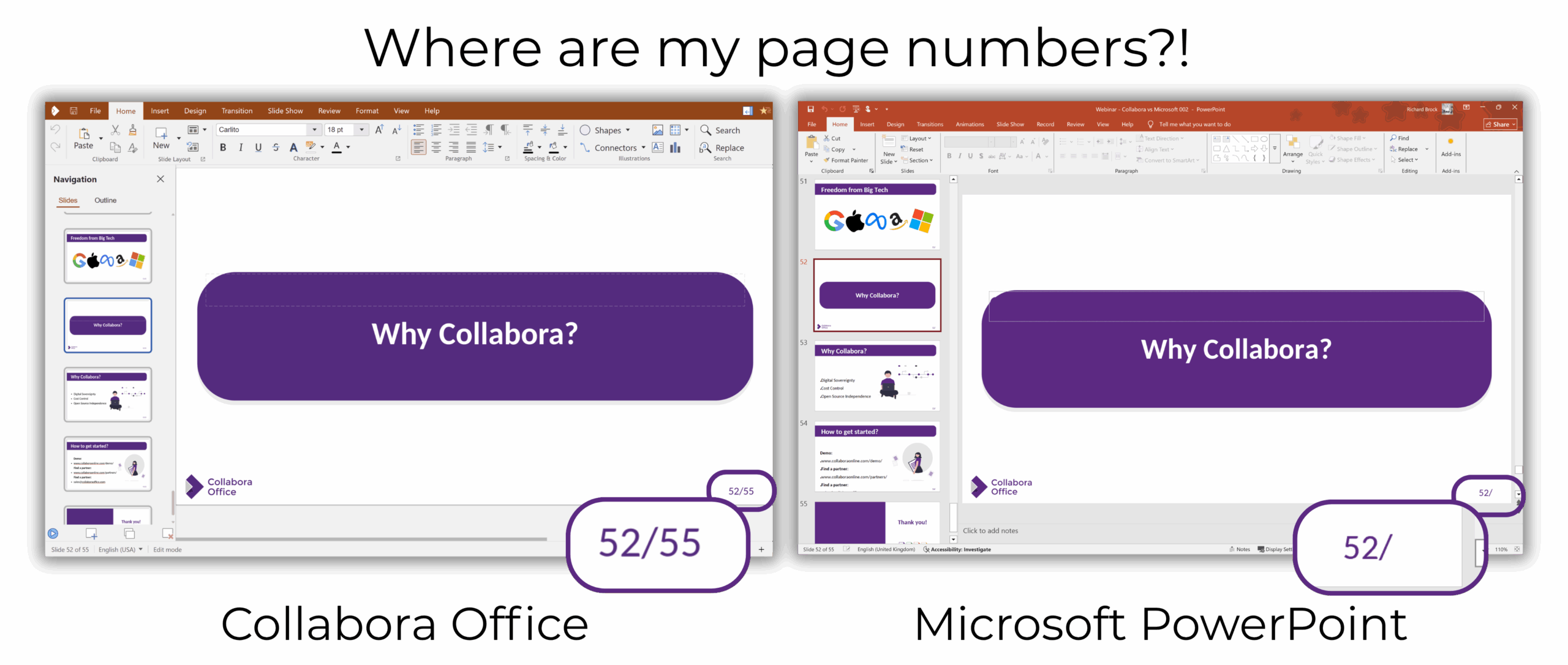
In short, if your strategy is to architect your software around Microsoft’s models, you can play with the UI styling and colours, but your product direction is being decided elsewhere.
You can call that interoperability, you can call it compatibility, for legacy workflows, it is certainly important and necessary. But you cannot call this strategy sovereignty.
OOXML is a legacy requirement, not a sovereign strategy
Realistically, organisations do need strong interoperability with Microsoft formats.
They exchange files with customers, suppliers, ministries, universities, courts, regulators, and partners, many of whom currently live in the Microsoft world. But the editing phase of a document’s life is usually very brief, even if it is to be archived for many years afterwards (for example the UK Healthcare Regulatory Agency mandates archiving medical records that are created in an afternoon for 25 years).
This is why moving forwards, OOXML should be treated as a legacy requirement, but it cannot be the foundation of a sovereign strategy. The strategic question is not whether you can open a .docx. Of course you need this. The strategic question is what format you want to build your future around.
If your answer is “whatever Microsoft does,” then you have not escaped the dependency – you are just reacting to it from a different server location.
A sovereign document strategy needs a format that is governed openly, developed through a genuine standards process, and not simply inherited from one vendor’s product decisions. That is where ODF matters. ODF is maintained through OASIS and published as an ISO/IEC standard. It is an open, international standard for text documents, spreadsheets, presentations, and graphics, developed through an open committee process. It is not “thrown over the wall” as the latest non-negotiable output of a single vendor’s decisions.
If you are serious about sovereignty, new templates, new internal workflows, and new documents should move towards an open standard you can actually participate in and build upon.
Old documents can remain old documents. They should be opened and rendered correctly, and archive formats like PDF and PDF/A remain important. Similarly, for the present time at least, external collaboration will continue to require excellent OOXML interoperability.
But new sovereign workflows should not be born dependent on Microsoft.
Don’t get confused by marketing
There is nothing wrong with saying a product has strong OOXML interoperability – we all work on it. The mistake is turning that into the main sovereignty story.
ONLYOFFICE, for example, leans heavily on this message. Its public materials describe its editor as using OOXML natively, with all files converted into the format “when opening and editing files”.
Quoting directly: “If the file format is different from OOXML, it will still be converted to the corresponding OOXML […] As the formats are fundamentally different, some data (such as charts, tables, autoshapes or images) and formatting can be lost due to the simple reason that some formats […] treat them differently than OOXML standard does.”
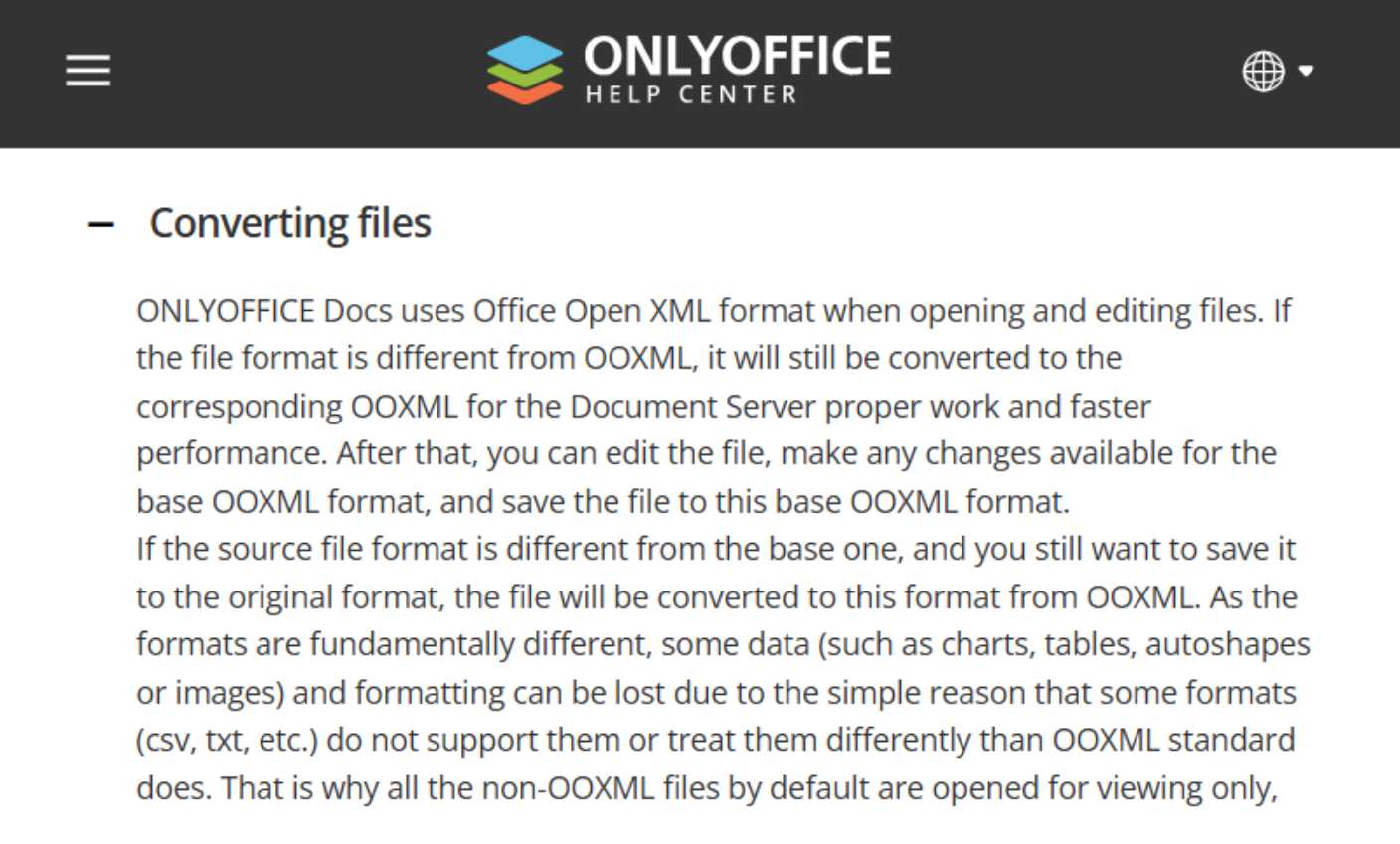
That’s great if you want to centre your digital strategy around Microsoft, but absurd as the centrepiece of a digital sovereignty pitch.
True interoperability is: “We can work with the legacy world.”
And true sovereignty says: “We won’t build our future around the proprietary past.”
If your product story begins and ends with how closely you follow Microsoft’s formats, then your roadmap is still architected by Microsoft.
Sovereignty is also about trust
Across the industry, buyers are starting to ask harder questions about where code comes from, who governs it, who controls the commercial rights around it, and whether the supply chain is something they can trust. So it is striking that some people seem willing to wave those questions away when it comes to the ONLYOFFICE code-base.
Public concern about the product’s Russian ties is not imaginary. TU Berlin for example announced that it was ending business relations with ONLYOFFICE and moving to Collabora Online, explicitly stating that, “ONLYOFFICE falls under the sanctions of the EU and Germany against Russia”.
Muddying the sovereign waters further, ONLYOFFICE’s own documentation states that ONLYOFFICE Docs Enterprise Edition is “distributed under a commercial proprietary license”. That alone should be enough for sovereignty-minded buyers to slow down and question their direction. What is open? What is closed? And what happens when the commercial incentives change?
Public campaign sites and community discussions have also pointed to the huge volume of Russian-language code comments, branding similarities with the Russian R7 Office suite, and a broader effort to distance the current commercial presentation from the project’s Russian history. Whether you agree with a national origin boycott or not, the underlying question raised seems fair – if buyers now care about provenance, why would they be relaxed about opaque or politically sensitive origins for such a critical layer of their document stack?
A serious sovereign strategy looks different
A serious sovereign office strategy is not anti-interoperability. It is not naive about legacy requirements, and it does not pretend the world can abandon Microsoft formats overnight.
It does something more serious than that. It supports legacy Microsoft formats, because reality demands it. It encourages ODF for new sovereign documents, because strategy demands it. And it chooses 100% open-source code, built in the open, for all to collaborate with – that strengthens independence rather than undermining it.
This is the real question for buyers evaluating office suites today. Not “Can it open a Word file?” Everyone can do that. But the harder and more important question is “Who defines the future of your documents?”
Where we stand
At Collabora Productivity, we are not confused about this.
Interoperability matters. Organisations need to work with Microsoft formats every day, and any serious office suite must support that reality. But sovereignty has to mean more than rendering the legacy world nicely, as we do.
It means open standards. It means giving organisations a path towards ODF for new documents and sovereign workflows. It means a platform built by a large, experienced team, in an open, friendly and welcoming community, and it means 100% open source code. Not open to a certain point, not open with strings attached, and especially not code controlled by countries hostile to free and open communications.
Don’t build on software endorsed by, and used by the Russian state and built around Microsoft’s file formats.
Free your documents today, with Collabora Office.