
Confused by buzzwords? You’re not alone.
EXPLAINED is a new explainer series for people who work with technology – but don’t want marketing fluff or academic theory.
We break down complex digital topics clearly and practically: what they mean, why they matter, and how they work in the real world.
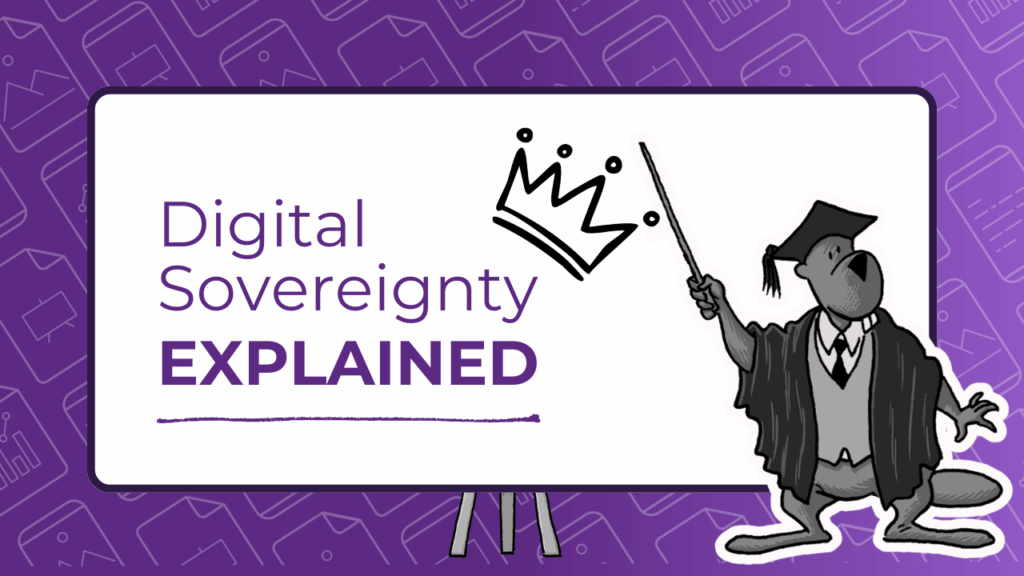
Digital sovereignty is the ability to make independent, enforceable decisions about your digital infrastructure – without being forced by vendors, platforms, or jurisdictions you do not control.
This might include but is not limited to:
- Where your data lives
- Who can access it
- What laws apply
- What happens if a vendor changes terms, pricing, or strategy
- Whether you can realistically switch providers
Crucially, it is not:
- A synonym for “on-prem”
- A rejection of cloud technologies
- A nationalist or isolationist idea
It is about control and choice.
Why digital sovereignty is suddenly everywhere
Because the ground shifted.
Over the past few years, digital sovereignty has moved from policy papers into the headlines. Court rulings, sanctions, sudden service withdrawals, and changes to data-access rules have all served as reminders that digital infrastructure is never neutral. Software and services are governed somewhere, data is subject to someone’s laws, and platforms ultimately answer to jurisdictions – not users. For many organisations, this has turned digital sovereignty from a theoretical concern into a deeply practical one.
A handful of large platforms now sit underneath email, documents, identity, storage, and collaboration. For governments especially, this raises an awkward question: can you really run public services on infrastructure you don’t control and can’t easily change?
What digital sovereignty is not?
Digital sovereignty is often misunderstood, partly because it increasingly gets used as a catch-all for very different concerns.
It does not mean rejecting the cloud, going back to on-prem-only infrastructure, or pretending global technology markets don’t exist. It is also not about nationalism with server racks, or building everything yourself from scratch.
At its core, digital sovereignty is about maintaining the ability to decide, even when vendors, markets, or regulations change. If your choices disappear the moment circumstances shift, sovereignty was never really there.
Where sovereignty actually breaks
Loss of digital sovereignty is rarely dramatic. There’s no single switch that gets flipped. Instead, it erodes quietly, layer by layer.
It might start with data that technically belongs to you, but only works properly inside one ecosystem. Or software that looks interchangeable on paper, but in practice only runs where the vendor allows it to. Sometimes it’s integration: “open” APIs that turn out to be undocumented, unstable, or strategically limited.
Deployment choices matter too. When SaaS is the only option, control over updates, lifecycle, and availability inevitably moves elsewhere. You don’t have to lose control everywhere for sovereignty to fail – losing it in one critical layer is enough.
Where open source helps
Open source is one of the strongest foundations for digital sovereignty.
Access to source code enables transparency, auditability, and long-term access. It reduces the risk of being locked out of your own infrastructure and makes it possible to change direction later.
Just as importantly, open-source solutions are built and maintained in the open by global, distributed communities and companies. Development happens in the open, improvements are shared publicly, and progress can be tracked directly – down to individual commits in a public repository. That openness is a powerful counterbalance to closed platforms and opaque decision-making.
Solutions such as Collabora Online and the many integrations and partners we work with combine these open-source foundations and open standards with professional support and flexible deployment options – including self-hosted and sovereign cloud environments. That combination is what turns theoretical freedom into something usable.
The trade-off nobody mentions
Organisations that prioritise sovereignty gain clearer exit options, stronger compliance positions, and more predictable long-term costs. In return, they accept that not everything is a black box handled by someone else.
So what’s the point?
Digital sovereignty is not about developing everything in-house, choosing national software providers, or hosting everything in your own underground vault. It’s about being able to choose your tools, understand your systems, and change course when needed.
If you’re interested in taking back control of your documents, contact us today.