
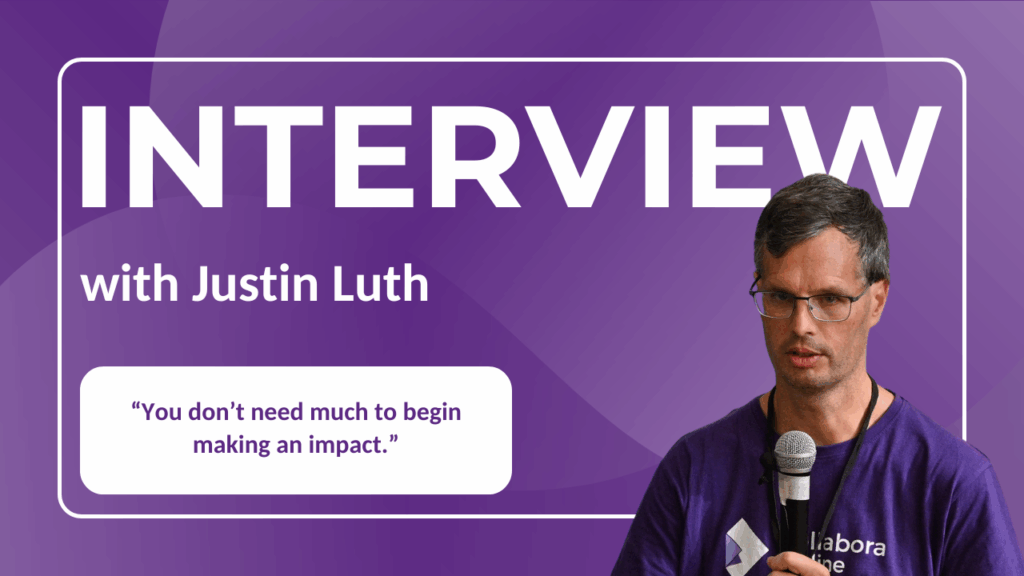
Welcome back to our interview series, where we chat with the passionate people behind the Collabora Online code. Collabora Online is made possible by the worldwide team, community, contributors and partners. Today, we’re sitting down with Justin Luth, a developer whose journey has taken him from the early days of DOS to solving complex technical challenges for a global user base.
About Justin
Justin Luth is a dedicated open-source contributor and software specialist with a deep background in computer science. Having spent a decade working in regions with highly limited infrastructure, he developed a unique perspective on the necessity of local-first, resilient software. A passionate advocate for digital sustainability, Justin balances his professional focus on bug fixing and quality assurance, with a love for long-distance cycling and a commitment to serving the global community through open-source development.
What first inspired you to get into tech?
In grade 12, I bought an Intel 8088 computer with DOS 3.3. That led me to study computer science in college on an SCO Unix system. Early on as a freshman, I knew this was what I wanted to be doing for the rest of my life. I loved everything about computers.
You’ve been a long-time advocate for open source. What does working in this ecosystem mean to you personally?
It means everything. I prefer to avoid proprietary systems entirely. I’m happy to have my contributions available for everyone in the world to benefit from. I’ve always marveled at the passion expressed by shareware. It reminds me of the New Testament’s early church community where believers share all things in common. I too wanted to share the specific talents I have for the common good of the global community.
How did you first hear about Collabora?
I’ve used StarOffice, OpenOffice, and LibreOffice ever since my overpriced license of MS Office 2.0 was no longer usable. After a few years of voluntary contributions to LibreOffice, Collabora reached out and offered to mentor me.
Why did you decide to contribute to Collabora Online?
My contributions to Collabora Online came in the form of underlying LibreOffice bug fixes, which I made while I was working in South Sudan. This was done to encourage SIL to switch to an open-source office so that our collaboration with the local population could be more sustainable.
Speaking of contributions, do you remember your very first one? How did it feel to see it go live?
My first 2014 contribution to LibreOffice was a fix for a macro that affected the wrong spreadsheet when multiple files were opened simultaneously. It took three weeks to make that two-line patch! When it went live, I felt relieved, but also empowered. It gave me the confidence and determination to promote LibreOffice and Linux to my African colleagues.
You spent a decade working in an environment with very limited internet connectivity. How did that influence your view of technology?
Because of that experience, I avoid non-local technology whenever possible. What I appreciate about Collabora is that it is based on LibreOffice—software that can be installed locally to guarantee availability. My contributions were often driven by the need for sustainable, open-source solutions that could be maintained locally. Interoperability—the ability to read and write Microsoft formats—is, in my view, the most important feature.
Is there a specific feature or project you’re most proud of?
I implemented “Alt-X” while working for SIL. It toggles a character into its Unicode number and back. Alt-X is especially useful when Unicode combining characters are involved. I was happy to see the wider LibreOffice community get excited about it as well. More recently, I’m proud of my Quality Assurance work using mso-test to find regressions. As an end user, I get very frustrated when something that used to work no longer does. Although regression testing is very tedious, it has proved to be quite valuable as well.
What is the best part about being part of the Collabora community?
Collabora has been excellent at providing mentors to advise me and review my contributions. I am a much more confident programmer because of their backing. Even senior developers were happy to assist me when I was just starting out. Collabora’s expert developers have consistently assisted me time after time.
What is a common myth about open-source contributing that you’d like to debunk?
That you need specialized knowledge or high-end equipment. My contributions started in an environment where we only had generator power, shared satellite internet, and end-of-life laptops. You don’t need much to begin making an impact.
For someone wanting to start contributing, what advice would you give them?
The most important requirement is the desire to contribute. That assumes that they have something important to them that they want to solve, and having that personally motivating ‘thing’ is critical to persevering.
I guess the second piece of advice is to feel free to “waste time” trying to figure it out on your own. Nothing is worse than having someone ask a question whose answer is only a google-search away. But on the flip side, don’t be afraid to ask for help when you find you are completely stuck (and show in your question that you have spent time researching the problem).
Finally, when you aren’t fixing bugs or testing regressions, how do you spend your time?
I enjoy 100km bike rides as a form of exercise during the summer.
Justin’s journey highlights that open source is about more than just code—it’s about creating sustainable, reliable tools that are reliable, accessible, and high-performing for everyone. Whether he is refining interoperability or cycling across the countryside, Justin’s commitment to the community remains a cornerstone of his work.