
It is interesting to see Euro-Office launched, with Nextcloud in charge. We would like to provide some initial thoughts here to address people’s questions.
Open Source is International
One of the great joys of FLOSS is working with a diverse international community, and being able to collaborate with lots of other smart and experienced people with deep domain knowledge around a code-base. This makes it possible to have the skills and knowledge spread around the world to convincingly make the code native in every nation – owned by everyone.
Collabora Productivity is privileged to have staff from across the world – with corporate entities in the UK and Germany. At last count our staff were around ~50% EU citizens, ~75% NATO (UK, Canada, Turkey etc.) and the rest around the world from India to Bolivia. That diversity gives deep a robustness to our project.
Russians are of course great people, but in today’s complicated geo-political space there are legitimate concerns about building on millions of lines of code extensively commented in Russian.
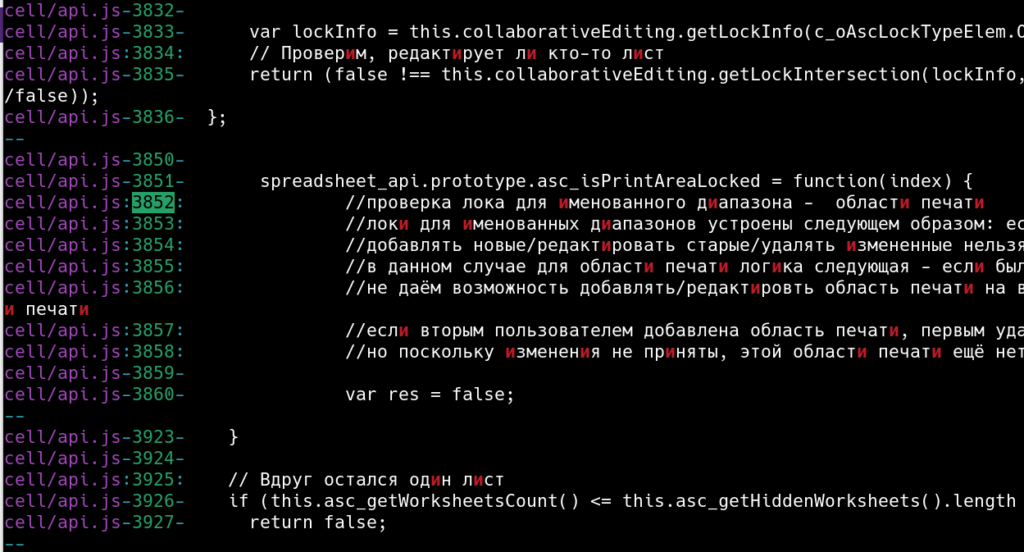
One of the hot topics currently is using AI to write code, with the concern that a malicious AI could introduce subtle and hard-to-see security vulnerabilities – hence a need for lots of careful and expert review. It seems clear then that there could be some reasonable suspicions around three plus million lines of code apparently written by a large team of Russians, substantially owned and controlled by a Russian Citizen, and apparently serving Russian state customers, no matter how lovely we can presume they are as individuals. Perhaps these days AI can be used to re-write the Russian comments to English, although the comments themselves are not the security concern. LibreOffice in contrast spent many years internationalising its German comments and code-base, trying to carefully preserve the original meanings.
Collabora Office’s German Roots
Ironically, the code-base of Collabora Office actually does have very deep roots in Europe, perhaps we should promote that more: from the heroic start by Marco Börries working in his Garage in Lüneburg, through his hiring and growing a talented team in StarDivision in Hamburg, onto an exit to US based Sun Microsystems – which amazingly chose to open-source the code as OpenOffice and return it to the world. Moving on a decade, after the Oracle acquisition The Document Foundation was created based in Berlin to steward the code-base, which it has done well for around a decade (although arguably has wandered from its purpose into in-fighting recently). Collabora Productivity of course is based in the UK and Germany, so I’d like to think we are pretty European – but a positive, outward looking European sort that loves to work with and to serve many cultures & nations.
European Values – the Rule of Law
One of the key Article 2 treaty values of Europe is the rule of law. And in this area Euro-Office seems to enter a space of some considerable debate and speculation, with differences of opinion between reasonable, like-minded community members on what the right thing is to do around licensing here both morally and legally.
For a long time OnlyOffice has used what looks like a proprietary or contradictory modified AGPLv3 license with added restrictions. Many argue that it is not an Open-Source product – though of course as a customer you can buy your own license from Ascencio. The OSI recommends not doing this:
“… combining an open source license with other terms will create a new license that is neither OSI-approved nor likely one that can gain approval. Any effort to change the terms of an open source license should be met with suspicion because they are likely designed to take away freedoms, or else an already OSI-approved license would have been suitable. The subterfuge is designed to “open wash” the software, claiming to use an open source license and hoping no one looks too carefully.” User beware: Modified AGPLv3 removes freedoms, adds legal headaches.
Against that the Software Freedom Conservancy has supported the case by PureThink against Neo4J.
The Euro-Office team appears to unilaterally change the license on Ascencio’s code: “Remove unenforceable and non-obligatory Section 7 additions from copyright headers…”.
It remains to be seen whether this will play out in the courts in Europe, it appears to be a risky move, but it may come up with useful precedent.
Open Standards
There is much to be said about surrendering Digital Sovereignty around document standards, and the dangers of architecting your software and future exclusively around Microsoft’s proprietary OOXML formats (even if a standards process described that without being able to change it). Rather than repeating those arguments it might be worth reading “You are not Sovereign if Microsoft still Architects Your Documents“.
What’s Next?
Collabora Productivity has competed with OnlyOffice’s unique team, product and licensing approach for many years, in the market, the community, and through our partner network.
It has been gratifying to see our clean approach increasingly winning in the market. We like to think that is driven by the strength of our feature-function improvements, strong partner relations, excellent support, product management – as well as for the sadder geopolitical and corporate origin reasons. It is thrilling to have been able to grow our team, make the software ever more beautiful, responsive, interoperable, and to give an ever better option to all of our customers and our growing partner base. To take a couple of examples we have enjoyed working alongside Government partners like openDesk by ZenDiS to shape and steer the direction of the software for their particular needs, or to have French Government staff involved in specific UI improvements, with so many more wonderful contributions from so many others – more than we can list – not to mention the many heroic COOL, and LibreOffice community contributors we love working with.
It will be interesting to see how Euro-Office evolves. Perhaps they can bring new clarity to worldwide legal licensing issues in this area, and ship an enterprise product around this; lets see how Nextcloud’s leadership drives the project. Building a great team of office productivity experts is not the easiest thing to do, so it is nice to hear of more engineers getting trained in our space who understand the scale of the task, and with whom we hope to swap horror stories over a beer at FLOSS conferences in the future.
Ultimately – this will come down to a customer and end-user choice: what do you want to support, contribute to, and build on for your users? I’m deeply confident in our foundations, in the depth and often decades of experience of our growing team handling our challenging problem space excellently – so for a European and international office suite I recommend Collabora Online – join us.